


Lightning
 When you're out hiking, you're at the mercy of nature for everything you didn't properly prepare for and for every little curveball thrown your way. Sudden storms, wild animals, rock slides, and flash floods are all examples of surprises that may pop up with little or no warning. You need to have a plan to deal with the most probable challenges and then good sense and skills to deal with anything else.
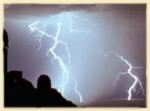
Thunder and lightning is one such surprise that you may experience. I love lightning! It is sooo cool to see the power of nature in such an intense instance of energy. Thunderheads in the far distance with bolts of lightning striking under them are an amazing site. Knowing when to enjoy the show and when to seek shelter is the difference between fun and misery.
Lightning Safety
 There was a park ranger named Roy Sullivan who died in 1983. During his career, he was struck by lightning 7 times - that's in the Guinness Book of World Records. The amazing thing is that he survived all 7 strikes - he wound up killing himself by committing suicide with a gun.
There are actually very few people struck by lightning while hiking, and less than 50 people killed in the US each year by lightning. That number is on a steady decline over the past few decades. If you stay alert and play it safe, you'll be just fine. You have the responsibility to act appropriately when threatened by lightning - there will be no warning sirens or announcements out on the trail.
Keeping an eye and ear tuned to possible lightning is important. You can determine the threat of lightning:
- Check weather reports before starting a hike. If storms are expected, be more vigilant. If nothing but blue skies are expected, relax a bit.
- Understand the general weather patterns for the area and season. In mountains, storms typically form in the afternoon so plan an early morning hike with the ability to get off the mountain quickly after lunch.
- Watch the horizon for cloud formation. Scan the horizon every 15 minutes or so and notice any clouds building.
- Watch distant clouds for lightning. If a cloud looks ominous or you see flashes, have your escape or safety plan ready and make sure everyone in your group understands it.
- Listen for thunder. Depending on wind, terrain, and distance, you may not hear thunder until lightning is already dangerously close. If you do hear thunder, you should be at or on your way to shelter.
- Determine the distance of lightning. If you see a lightning flash, count the seconds until you hear thunder. Divide the number of seconds by 5 to approximate the distance in miles.
30/30 Rule
Count the seconds from the lightning flash until thunder is heard. If it is less than 30 seconds, you should already be in shelter. Lightning can strike 6 miles away from the thunderhead, and occasionally even farther. If it's less than 30 seconds and you are not at your shelter site, you need to take quick action.
Stay inside shelter until at least 30 minutes after hearing the last roll of thunder. This gives time for the storm to pass and minimizes your chance of being struck.
Avoiding Lightning Strikes
 There is no completely safe place from lightning. Houses get hit, cars get hit, trees, animals, and people all get hit. Minimizing your strike probability is the name of the game.
If there is an enclosed building nearby with plumbing and/or electric outlets, that makes the best shelter and you should retreat there. Picnic shelters and other open structures do not offer protection from lightning.
If you are at the trailhead, get in your car, roll up all the windows, and don't touch anything metal.
Assuming you are on a hike away from buildings when a lightning storm catches up with you, use these lightning safety guidelines:
- Do NOT seek shelter under a picnic shelter, lone tree, or other object to keep you dry. It will attract lightning. The rain won't kill you so its better to be wet and alive than dry and dead.
- Come down from high places. Seek a valley or depression in the terrain. Be careful of entering a drywash that may channel a flashflood from the rainstorm.
- Seek shelter in a low stand of trees. This will help keep you dry and not attract lightning.
- If you are above treeline, seek shelter in the lowest area you can reach, preferably with large boulders around so you can get some protection from driving rain behind some smaller boulders.
- Put on your raingear and remove your backpack.
- If you have a metal frame pack, leave it 100 feet from where you are seeking shelter.
- If you have a hiking stick or poles, leave them with your pack.
- Your group should not huddle together. Instead, have each person find shelter about 100 feet apart. This minimizes the possibility of multiple casualties from a single strike.
Realistically, due to the situation being dark, wet, windy, cold, loud, and dangerous, allowing members of your group to shelter in buddy pairs will help reduce the level of stress and fear while increasing the possibility of multiple victims a bit.  If you are not able to get to any shelter, you need to become a small, round target and cross your fingers. Minimize your contact with the ground and minimize your height. Crouching down on the balls of your feet placed close together with your head tucked down is the recommended position. This position reduces your exposure and encourages any lightning strike to travel down your back and hopefully have less damage to vital organs. Lightning travels through the ground from the point of impact in random tendrils similar to tree roots. The smaller your footprint, the less chance there is of you being shocked from a nearby strike.
- Cover your ears and close your eyes to protect from the intense noise and light of nearby strikes.
Lightning First Aid
 Lightning is an extreme electric shock and has similar first aid requirements for burns and stopped heart.
- Immediately after a close strike, do a headcount of everyone in your party having them call back to you that they are ok. If someone does not respond, go to their location. Only allow those you need to gather. Keep everyone else spread out since there is still danger of additional strikes.
- There is no electrical residue after a strike. It is safe to touch someone that has been struck.
- If there are multiple victims, prioritize care needed. A victim that is not breathing is highest priority. There is a relatively good chance of reviving a lightning victim with CPR.
- Check for and give first aid for burns. Check around jewelry, buckles, and fingers and toes especially.
- Treat for shock, keeping the victim warm and calm.
 Avoiding Sun Problems
 Hiking Tips
All Comments:
Jul 05, 2012 - Charle
Sep 10, 2012 - Jon
Sep 10, 2012 - Hiking Dude
Mar 21, 2014 - Gen
Jun 02, 2014 - Austin
Jun 02, 2014 - Hiking Dude
Nov 06, 2014 - sharna pugin
Nov 06, 2014 - Hiking Dude
Sep 08, 2015 - Lauren
Aug 09, 2016 - Anton
We have discussed the danger of being what seemed to be inside a thunder cloude, compared to be beneath. Is it more dangerous? What should you do in a situation like that?
We seeked low and layer our gear a little off, but after some time it got worse, and we took the chance to seek shelter in a cabin lower down.
-Anton
Aug 09, 2016 - Hiking Dude
I suppose the cabin was not grounded so being in it wasn't much protection from lightning, but you were safer from the cold and rain. Also, if it was at a lower elevation with a forest around then it would be safer.
I had two nights of very close lightning up in the mountains about a week ago. Even though our tent was in the best possible location, whenever you are outside you are vulnerable and it's tense.
Oct 07, 2016 - Esther
I am about to do the Camino Ingles through Galicia, northern Spain in May 2017. Quite a lot of the walk will be through eucalyptus forests. There are no shelters when we're in the forests and we could be in there for several miles.
What do we do if the thunder comes and we're under the trees.
I might add that I'm a granny of three and my cousin who I'm travelling with has a pacemaker, so we won't be running very far in an emergency!
Oct 07, 2016 - Hiking Dude
Mar 06, 2017 - jeanna
Mar 14, 2017 - Hiking Dude
Sitting, or crouching on your feet as in the picture above, in a tent makes you a smaller target than lying stretched out in your sleeping bag for lightning that hits the ground nearby.
Apr 18, 2017 - Black Bear
Apr 18, 2017 - Hiking Dude
Oct 14, 2017 - Greg
So I descended as far as I could, but not much because you can't descend safely in conditions like that. I did put my pack aside with my poles. And stayed low just as in a picture. For some 10 minutes. It was so scary. You are sitting there and literally praying. I'm feeling it was like for several hours. The time doesn't pass, as the thunderstorm. Closing my eyes I still see the flashes. Some hitting the ground in less then a second.
Then I started to feel pain in legs. I couldn't sit in this position any more, so I went to the pack, pulled out sleeping pad and put it folded So I could sit on several layers of it. I was sitting there for something like an hour. But it feeled like infinity to me.
Being alone in that situation is the worst thing. Even I understood that the probability for lightening striking me is not high, the mental stress was so bad. I started to convince myself to do stuff just in order to do something because this makes you focus on something else rather than the storm. I pulled on wormer clothes, put my rain gear, recorded the coordinates, SMSed my wife about the situation and my location.
I'm still not sure what I've done wrong. I searched the web for reasons. Probably reading cloud pattern is a missing skill as well as plain luck.
May 15, 2019 - Keith
May 15, 2019 - Keith
Jul 15, 2019 - Jessica
Feb 13, 2021 - Cora Mahon
Mar 21, 2021 - Billy
Jul 28, 2021 - Brandon K Lenssen
Aug 06, 2021 - Hiking Dude
Aug 06, 2021 - Tortoise
I have read in a couple other places about making sure your ankles touch when in the lightning position. It is believed that if a ground current strikes you it might exit once it gets to your ankles rather than going through your whole body - I'll be adding that to my lightning defense toolkit as I return to do more of the trail in a few days.
Oct 07, 2021 - Lisa
Oct 13, 2021 - Hiking Dude
Ask a Question
Find more Hiking Resources at www.HikingDude.com
Follow Me
Recent Comments